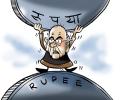
While the finance minister had a great opportunity to come out with flying colours while presenting this last Budget of his government, he didn't, says Omkar Goswami.

India's sovereign credit ratings do not reflect the economy's fundamentals, the Economic Survey said on Friday and nudged the global agencies to become more transparent and less subjective in their ratings. The Economic Survey 2020-21, tabled in Parliament, said that sovereign credit ratings methodology must be amended to reflect economies' ability and willingness to pay their debt obligations, and suggested that developing economies must come together to address this bias and subjectivity inherent in sovereign credit ratings methodology. "Never in the history of sovereign credit ratings has the fifth largest economy in the world been rated as the lowest rung of the investment-grade (BBB-/Baa3). While sovereign credit ratings do not reflect the Indian economy's fundamentals, noisy, opaque and biased credit ratings damage FPI flows," the survey said.

A high CAD puts pressure on the rupee, which in turn makes imports expensive and fuels inflation.

'It is a package for a new self-reliant India.'
BJP is hiding behind a GDP number which is being challenged. People are not dazzled by it, but are asking 'where are the jobs?'

'The finance minister in her Budget speech should spell out how exactly she intends to get back to the 7% track, and the hard decisions she intends to take in order to adjust to the realities of a slowing economy until growth momentum returns,' suggests T N Ninan.

Global warming can cause extreme floods and droughts and can mean snowfall is replaced by rain, with higher evaporation rates.

Lower gold imports and higher overall exports to help narrow the gap.
President emphasises on innovation for economic progress.
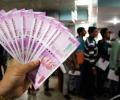
'This is not without risk because extraordinary steps taken in exceptional times have the habit of becoming habits until the next crisis intervenes,' warns T N Ninan.

'India and China have the wise and sage leadership to steer this complex relationship in the coming decades.'

Country's largest lender the State Bank of India (SBI) will sell bad loans amounting to Rs 3,000 crore (Rs 30 billion) in the last quarter of the ongoing fiscal, the top official of the bank said on Saturday.

'A sustainable growth rate of 8 per cent is evidently some distance away,' says T N Ninan.

Currently, India recycles around 300 of the 1,000 ships which are demolished per annum globally. However, countries like Japan, Europe and the US were not sending their ships for recycling to India in the absence of ratification of a global convention. That scenario is set to change with the Recycling of Ships Act, 2019.

Even as both India and the world struggle to re-build after COVID-19, they face slow-burn problems that could develop into full-blown crises, observes T N Ninan.

The WPI has been in the negative zone since November.

'We all wanted a strong Centre with a decisive mandate from the people, to allow them to take bold decisions.'
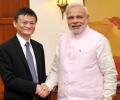
Alibaba's pervasive economic and social influence in China is seen as a threat to the authority of the Chinese Communist party, notes Shyam Saran.
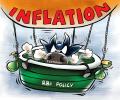
RBI Governor Shaktikanta Das on Friday said that inflation is on a declining trajectory, as it has fallen by 170 basis points from its January 2020 peak. Retail inflation fell to four-month low of 5.91 per cent in March over the previous month, mainly due to easing food prices.
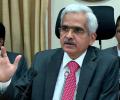
Das favoured shifting the stance of monetary policy from neutral to accommodative to send a clear signal, indicating that more measures could be taken in the near future to boost growth.

The London School of Economics professor Danny Quah forecasts that by 2050 the world's economic centre of gravity, a theoretical measure of the focal point of global economic activity based on GDP, will have shifted eastwards, as quoted in the Wealth Report 2012 by Knight Frank & Citi Private Bank.

Government should focus on five areas in this year's Budget, says Sunanda Sen, a former professor at Jawaharlal Nehru University.

The government has chosen to profiteer off people's misery and suffering, Gandhi said.

'Most of the measures the finance minister announced will take effect after the lockdown.' 'By that time, millions of people will be starving.'

China would be an influential player in the bank

Are short-term compulsions increasing long-term instability?
Chidambaram was also hopeful that fiscal deficit will be contained within the targeted 5.3 per cent of the GDP this fiscal and trimmed to 4.8 per cent in the next.

'The outlook for private investment, which has been such a weak link for India for so long, remains challenging.'

'We don't expect any immediate impact on salaried jobs.'
Ahead of the Economic Survey, industry body Ficci today lowered its GDP growth forecast for the current fiscal, pegging India's economic expansion rate at 5.3 per cent compared to its 5.5 per cent previous estimate.

He rued that people who work hard and honestly are put through enormous difficulties and Indians excel in making an ordinary task into an extraordinary one.

And why markets could give up 25 per cent of all these gains made since March 2020

India had been growing around 8-9 per cent before theglobal financial meltdown of 2008. The growth rate in 2011-12 slipped to nine-year low of 6.5 per cent.

During a three-hour long virtual meeting with CEOs of large public and private sector banks along with heads of NBFCs, the prime minister assured them that the government is ready to take all steps to support the financial sector.

A normal monsoon, softer interest rates and inflation, pent-up demand, along with mild budgetary support may help growth pick up in coming quarters.

The government hiked import duty on gold to 10 per cent and the RBI also imposed curbs on its imports by linking it with exports.

Going forward, the February factory output may be impacted as several industries such as automobiles, technology, pharma and fashion have some exposure to imports of raw and intermediate materials from China.

Finance Minister Nirmala Sitharama on Thursday stated the government is planning to provide a relief package of Rs 1.7 lakh crore to the underprivileged, poor and migrant workers affected by the lockdown amid the coronavirus outbreak. The scheme has been named the Pradhan Mantri Garib Kalyan Scheme.

RBI also retained its GDP growth forecast at 7.6 per cent
.jpg)
Prime Minister's key economic advisor C Rangarajan on Friday lowered the growth forecast for the current fiscal to 5.3 per cent from 6.4 per cent projected earlier and listed out host of measures, including further liberalisation of FDI norms to improve economic condition.
 © 2026 Rediff.com - Advertise with us - Disclaimer - Privacy Policy - Sitemap - Feedback - About us - Terms of use - Grievances